


TL;DR
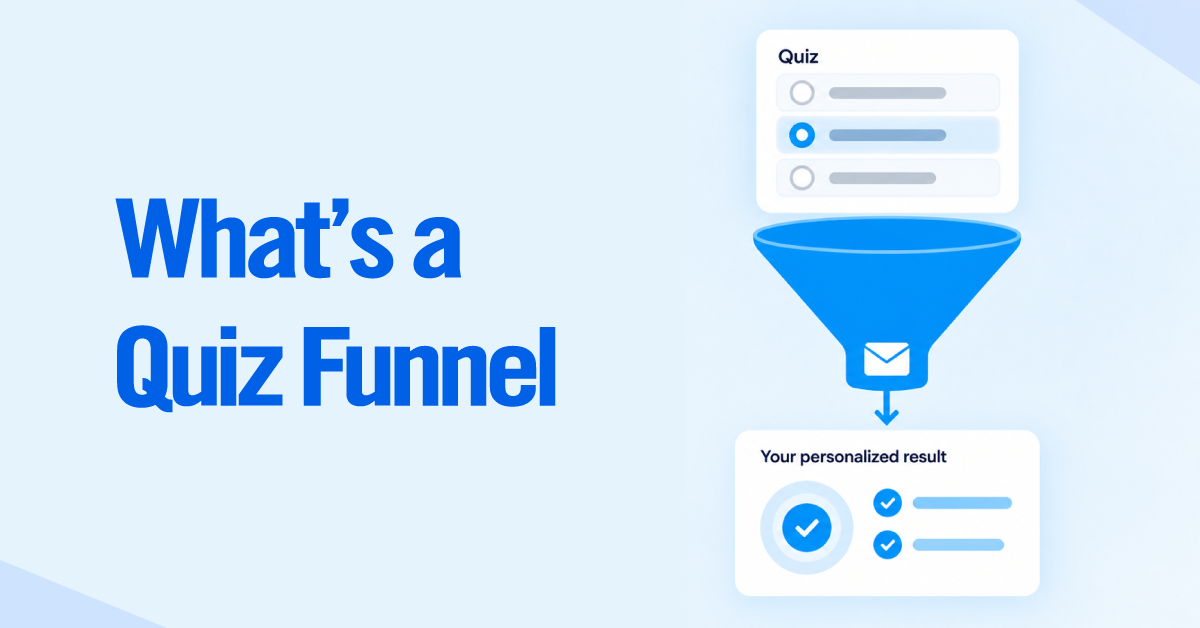
- Quiz funnels replace static forms with interactive quizzes that deliver personalized results in exchange for an email.
- The flow is simple: answer questions, get segmented, opt in, and unlock a personalized result.
- Different quiz types support different goals, including product recommendations, lead qualification, diagnostics, and scored assessments.
- Quiz funnels often generate higher engagement, with Interact reporting a 40.1% start-to-lead rate among quiz starters.
- Measure success using three metrics: start rate, completion rate, and opt-in rate.
- You can build quiz funnels in Typeform, Jotform, or Gravity Forms using logic jumps, scoring, and result pages.
A quiz funnel is a lead generation process that replaces a traditional sign-up form with an interactive quiz. Instead of asking visitors for their email address right away, it guides them through a series of questions, provides a personalized result, and then asks them to enter their email to view it. This approach creates value before requesting contact information, inspiring confidence that it can improve conversions over standard opt-in forms.
If your landing page attracts plenty of visitors but struggles to generate leads, that is likely why. Most people are reluctant to share their email address without a clear benefit. A quiz gives them a reason to participate first and rewards them with a personalized outcome, making the opt-in feel worthwhile. This understanding helps you avoid common pitfalls and build more effective funnels.
How a Quiz Funnel Works
A quiz funnel works by trading a series of small, low-friction questions for a personalized result, then capturing the email right before that result is revealed. Every step is designed so the next one feels easier than the last.
Here is the mechanism, start to finish.
- Cover page. A short, benefit-led hook that promises a specific, useful outcome (your skin-type routine, which plan fits your business, your readiness score). This is the single biggest lever on how many viewers actually start.
- Questions. A short set of quick questions, one idea per screen. The right number is however many it takes to return an accurate, differentiated result, and each answer is a micro-commitment that pulls the visitor forward.
- Segmentation. Behind the scenes, scoring logic and conditional branching (logic jumps) sort each respondent into a result bucket based on their answers. Hidden fields quietly pass through UTM data so you know which campaign each lead came from.
- Email capture step. The opt-in sits right before the payoff, not before the first question. The visitor has already invested effort and wants the result, so asking for an email here feels like a fair trade rather than a toll gate.
- Outcome page. The personalized results page delivers what was promised and points to the next action, whether that is a product, a booking link, or a tailored email sequence.
That final sequence is where the segmentation earns its keep. Because you captured the result bucket, someone who told you their main issue is cart abandonment gets a different follow-up than someone worried about low order value.
Quiz Funnel Examples
Quiz funnels show up in a few common subtypes, and seeing each one in concrete terms makes the format click faster than any feature list. The scenarios below are illustrative composites written to show how each subtype works, not accounts of specific clients.
Product Recommendation Quiz (Ecommerce)
A product recommendation quiz asks about needs and preferences, then recommends specific products in exchange for an email.
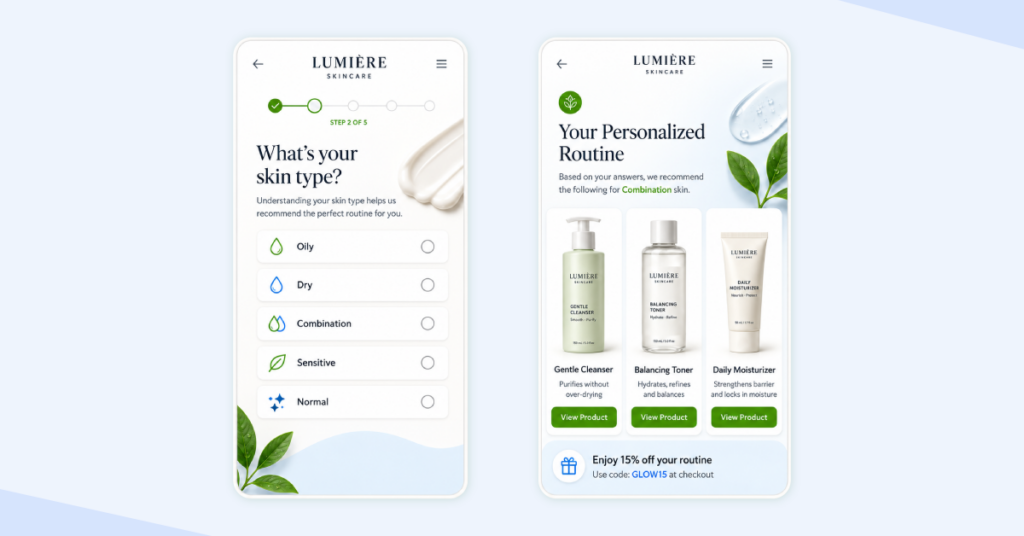
A skincare brand asks about skin type, top concern, and current routine, then returns a three-product regimen plus a first-order discount sent to the email address entered. The shopper gets a clear answer to “what should I actually buy,” and the store gets a qualified subscriber who has already described exactly what they want.
As a documented example, Interact reports that the specialty retailer Henry’s House of Coffee reached a 68% conversion rate with a product recommendation quiz tuned to customer taste preferences, well above the platform’s 40% average.
Lead Qualification Quiz (Services and B2B)
A lead qualification quiz filters and scores prospects before they ever reach your calendar. An accounting firm or a wealth-management practice asks about the prospect’s situation, revenue band, and timeline, scores the answers, then routes hot leads straight to a booking link while sending everyone else into a nurture track. The sales team stops burning hours on discovery calls that go nowhere.
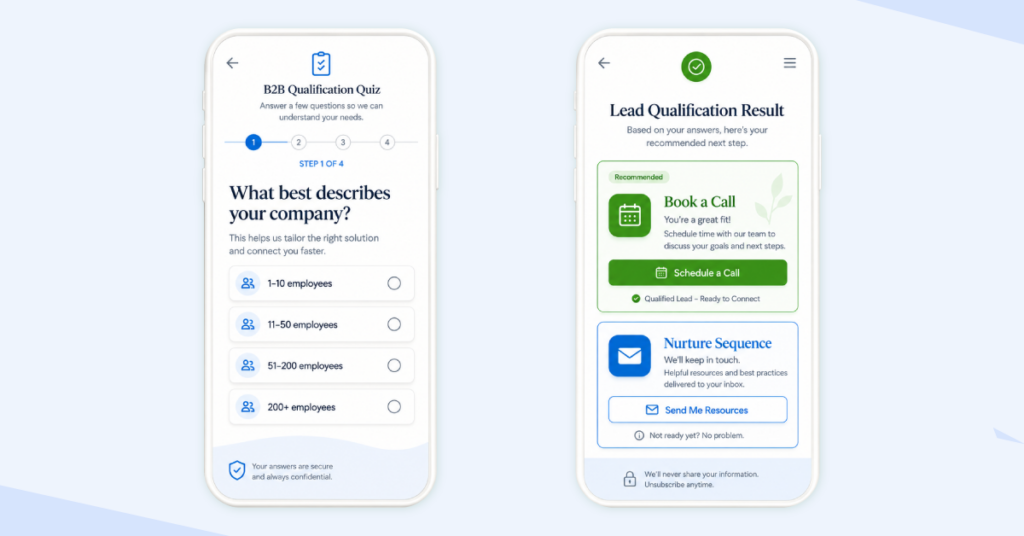
In one client engagement, we replaced a SaaS company’s basic contact form with a Typeform qualification funnel that routed qualified leads into HubSpot. That project produced 63% more demo requests and 40% fewer unqualified calls. It is a documented result from a single engagement, not a rate you should expect by default.
Diagnostic or Personality Quiz (Health, Beauty, Coaching)
A diagnostic or personality quiz tells someone something true about their own situation, which is why it converts so well in health, beauty, and coaching.
A fitness coach runs a “What’s blocking your progress?” quiz that returns a specific bottleneck and a matched plan. A beauty brand runs a hair-type diagnostic that ends in a custom routine.
The result feels personal because it is, and that reciprocity is what earns the opt-in.
Scored Quiz (Assessments and Readiness Scores)
A scored quiz assigns point values to answers and sorts people by their total score rather than by a category or personality type.
This is the subtype behind readiness assessments and maturity scores; for instance, a “How automation-ready is your business?” quiz that returns a numeric score and a tier such as beginner, intermediate, or advanced, each with its own recommendation.
Scored quizzes overlap heavily with lead qualification, since the same score that gives the visitor a result can also tell your sales team how hot the lead is.
Quiz Funnel Conversion Rates (What the Data Actually Shows)
Quiz funnels can convert meaningfully better than static forms, but the honest number depends entirely on which checkpoint you measure. The most-cited industry figure comes from Interact, which has tracked quiz performance across more than 80 million leads.
| Interact’s benchmark puts the average start-to-lead rate at 40.1%, a figure it reports as roughly steady since 2013 across more than 80 million leads. Read the denominator carefully, though. That 40.1% counts people who already clicked to start the quiz. The 10 to 20% it and others contrast against comes from standard lead magnets like an ebook or checklist, and Unbounce’s analysis of 41,000 landing pages puts the median landing page nearer 6.6%. Those static figures are usually measured against all visitors, so a raw side-by-side with a start-based quiz number overstates the real gap. Sources: Quiz Conversion Rate Report 2026 | Interact Blog Generate Leads with a Meta Ads Quiz Funnel | Interact Blog |
The trap is quoting one blended number and calling it “the” conversion rate. A quiz funnel has three distinct drop-off points, and each one is worth tracking on its own.
Start Rate (Visitors Who Begin)
Start rate is the share of people who see the quiz and actually click to begin, and it hinges almost entirely on your cover page. For well-built funnels, this view-to-start ratio commonly lands around 70%, with Interact reporting 71% on Meta Ads quiz funnels.
If your start rate is low, the problem is usually a cover page that is too vague or too busy rather than anything inside the quiz itself.
Completion Rate (Starters Who Finish)
Completion rate is the share of people who begin the quiz and answer every question, and Interact puts the average at 65%, with 66% on its Meta Ads funnels. Well-built, well-matched funnels can achieve higher rates, and some vendors report averages near 85% for tightly designed quizzes.
Length is the main driver here. Completion tends to slide the longer a quiz runs, so relevance rather than a fixed cap sets the right length. Keep the questions that change which result bucket someone lands in and cut the ones that do not.
Opt-In Rate (Starters Who Become Leads)
Opt-in rate is the share of people who start the quiz and end up submitting their email, since the email gate sits at the end of the questions. Interact puts this start-to-lead figure at 40.1% on average and reports it running near 50% for service providers and even higher for standout funnels like the Henry’s House of Coffee example above.
Whatever number you use, keep the denominator fixed. We measure it here against people who started the quiz, the same base used for completion rate, so the two checkpoints stack cleanly (more people finish the questions than ultimately submit an email at the gate).
The 10-20% usually cited for a standard lead magnet is a different denominator again, since it is measured against all visitors rather than quiz starters. To compare like for like, chain the stages.
If roughly 70% of viewers start and about 40% of those become leads, the view-to-lead rate is near 28%, ahead of a typical static page but well below what a raw 40% figure would imply.
What edge exists comes from placement and reciprocity, since by the time the email step appears the visitor has already invested effort and been promised a specific, personal payoff.
| Checkpoint | What it measures | Denominator | Figure from published sources |
|---|---|---|---|
| Start rate | Viewers who click to begin the quiz | All viewers | 71% on Interact’s Meta Ads quiz funnels |
| Completion rate | Starters who answer every question | Quiz starters | 65% average (Interact); higher for tightly built quizzes |
| Opt-in rate | Starters who submit their email | Quiz starters | 40.1% average (Interact), near 50% for service providers; not comparable to the 10 to 20% of all visitors quoted for standard lead magnets |
These are illustrative ranges drawn from published industry data, not a guarantee. Your actual numbers depend on traffic quality, offer relevance, and the quiz’s build quality. The point is to measure all three, so you know which stage is leaking.
Why Quiz Funnels Often Convert Better Than Static Forms
When they are well built and aimed at the right audience, quiz funnels tend to convert better than static forms because they replace a single cold ask with a series of small, easy commitments that culminate in a payoff the visitor actually wants.
Three plain-English mechanics do the work.
- Micro-commitment. A static form asks for everything at once, which is a big psychological jump from a standing start. A quiz asks one small thing at a time, and each answer makes the next one feel natural. By the email step, the visitor has already said yes several times.
- A sense of progress. Answering questions and watching a progress bar move feels like getting somewhere. That momentum is what carries people past the point where they would normally abandon a form.
- A personalized payoff instead of a cold ask. A form offers “join our list.” A quiz offers “here is your specific result.” The visitor is trading their email for something built around them, so reciprocity does the persuading rather than pressure.
It is a better-sequenced version of the same ask, structured so the friction lands where the visitor is most motivated to push through it.
Where Quiz Funnels Fit in a Marketing Funnel
Quiz funnels live at the top and middle of the funnel, where they convert cold traffic into segmented, qualified leads rather than anonymous form fills. They fit most cleanly in businesses that live and die by lead quality.
- Financial services (wealth management, debt settlement, merchant cash advance) use qualification quizzes to score prospects on situation and readiness before a rep ever picks up the phone, so time goes to leads who can actually close.
- Professional services (legal, accounting and tax, consulting) use diagnostic quizzes to help a prospect self-identify their problem, thereby pre-framing the sales conversation and filtering out poor-fit inquiries.
- Home and field services (roofing and trades, appliance repair, pest control) use short intake quizzes to capture job type, urgency, and location, then route the request to the right team automatically.
- Ecommerce uses product recommendation quizzes to guide undecided shoppers to the right item while building a segmented email list at the same time.
In every case, the quiz is doing two jobs at once. It captures the lead, and it segments them so that the follow-up can be specific from the first message.
Common Mistakes That Kill Quiz Funnel Conversion
Most underperforming quiz funnels fail for the same handful of reasons, and all of them are fixable. A few of the biggest offenders are worth naming here.
- Too many questions: Every question that does not change someone’s result adds friction without adding accuracy, and completion slips as the quiz drags. Keep the questions that affect the outcome and drop the rest.
- Generic results: If the outcome page reads the same regardless of how someone answered, the personalization is obviously fake, and the opt-in falls apart. Each bucket needs its own copy and recommendation.
- Asking for the email too early: Asking for an email before showing any value reads as a bait-and-switch. The opt-in belongs after the last question, not before the first.
- No segmented follow-up: Capturing the result bucket and then emailing everyone the same sequence throws away the whole advantage.